
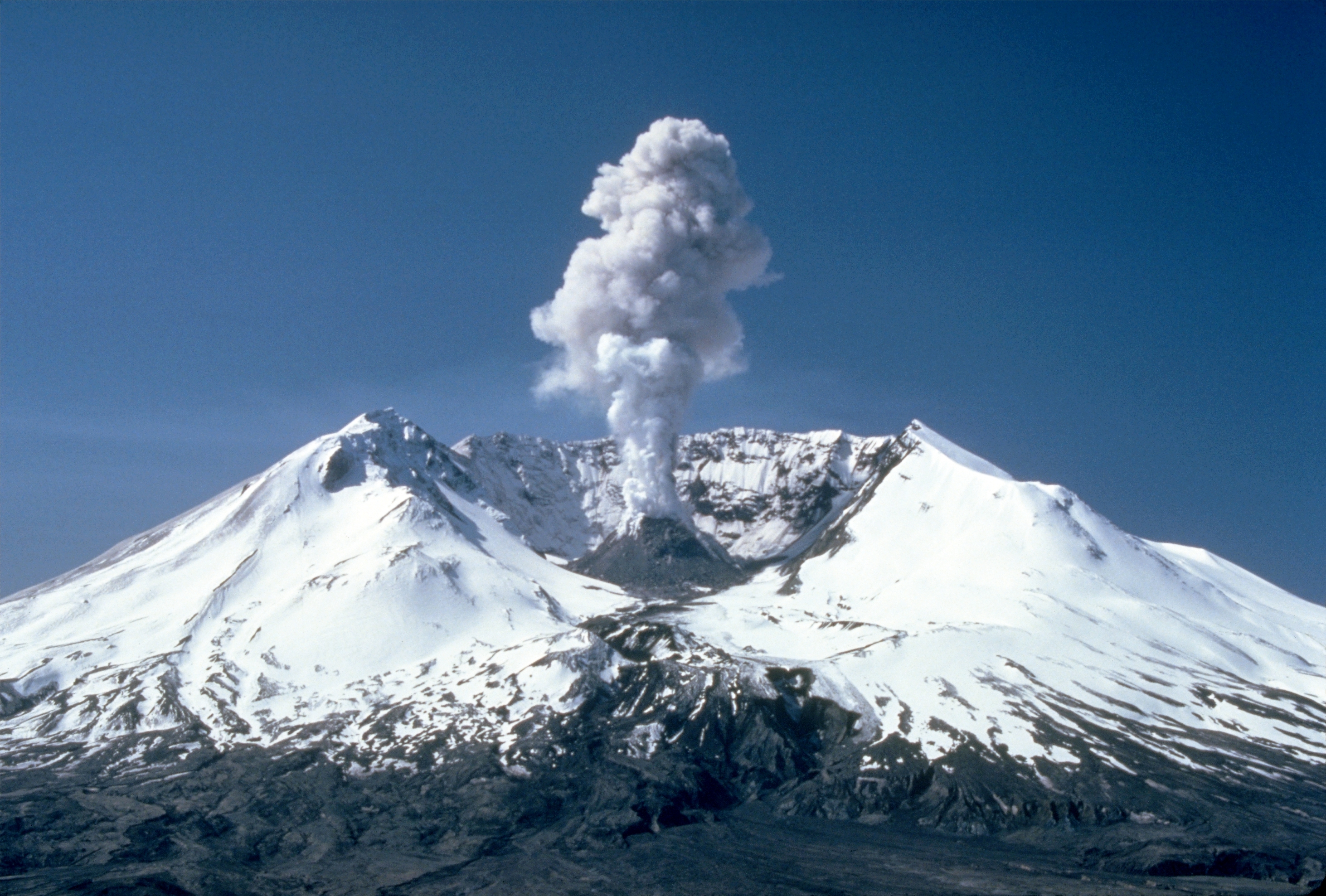
Mount St. Helens has been in my social media feed a lot this week as we mark the anniversary of the volcano’s eruption. All these years later I still marvel at before-and-after photos of what had been Washington’s third highest peak, with over 1,300 feet of mountain blasted into the sky or avalanching down stream beds. The eruption took 57 lives and damaged hundreds of homes, miles of highway and railway, and utterly changed the landscape.
I was in elementary school at the time and obsessed over an honest-to-goodness volcano in our very own country. My grandmother had a friend in eastern Washington send a small bottle filled with gray volcanic ash collected from her yard. I cherished that bottle and had it for years and years and years, only to lose track of it a while back.
Why isn’t Mount St. Helens a national park? The area is claimed by the Cowlitz Indian Tribe and Confederated Bands of the Yakima Nation, but at the time of the eruption title holders included the U.S. Forest Service; the Weyerhaeuser Timber Company, which harvested lumber around the mountain; and the Burlington Northern Railroad, which owned the actual peak.[1] Following the eruption, the Mount St. Helens National Volcanic Monument Act traded the volcanic area for other forest land, and the U.S. Forest Service assumed management.
While some national parks were subject to logging more than a century ago, they’ve become largely harvest-free zones. The U.S. Forest Service manages land, but they also manage the natural resources on that land. Logging is a big part of their portfolio. National forests are beautiful places, but they’re also managed so companies like Weyerhaeuser can create lumber, paper products, and chemical derivates. Several national parks bear the scars of their industrial pasts, like Canyonlands’ uranium mining road, Death Valley’s borax smelters, or New River Gorge’s coal mines. At Mount St. Helens, creating a national monument preserved the area for scientific study, but there were still millions of trees that could be harvested and put to good use.
I can verify the logging potential firsthand. A few years after the eruption, my family took on one of our epic road trips. Little did we know we would have a too-close-for-comfort encounter with Mount St. Helens.
In retrospect we doubt the map we picked up in Portland was legit, but we trusted its cartographic accuracy as we set out to get a close-up look at the volcano. We followed the thin lines representing narrow roads winding through forests of evergreen under an ash-colored sky. Peering out the window, I guessed where the remnant of the summit could be, but the trees and clouds didn’t cooperate. Switchback after switchback, the road got narrower as it climbed, limiting my field of view.
We rounded another switchback and slammed the brakes: a huge, fully-loaded logging truck with a bright red cab blocked our path. Probably used to looky-loos getting in the way of his work, the truckdriver informed my dad that we were eight miles inside the restricted zone. Eight miles! We didn’t think twice—we got out of the truck’s way, did a three-point turn, and followed him out of the no-go zone. The car was pretty quiet until we saw the fast-food clown restaurant at lunchtime.
Will Mount St. Helens someday be a national park? It’s certainly a great candidate given its unique status as the Lower 48’s most active volcano and the way humanity has left the environment alone to learn how it recovers. Visitor centers, educational programs, and hiking trails would lend themselves to a national park easily. Mount Rainier National Park (45 miles north) and Crater Lake National Park (about 210 miles south) are remarkable parks in their own right, and Mount St. Helens would be a great addition to the system.
I hope they straighten out those logging roads first.