
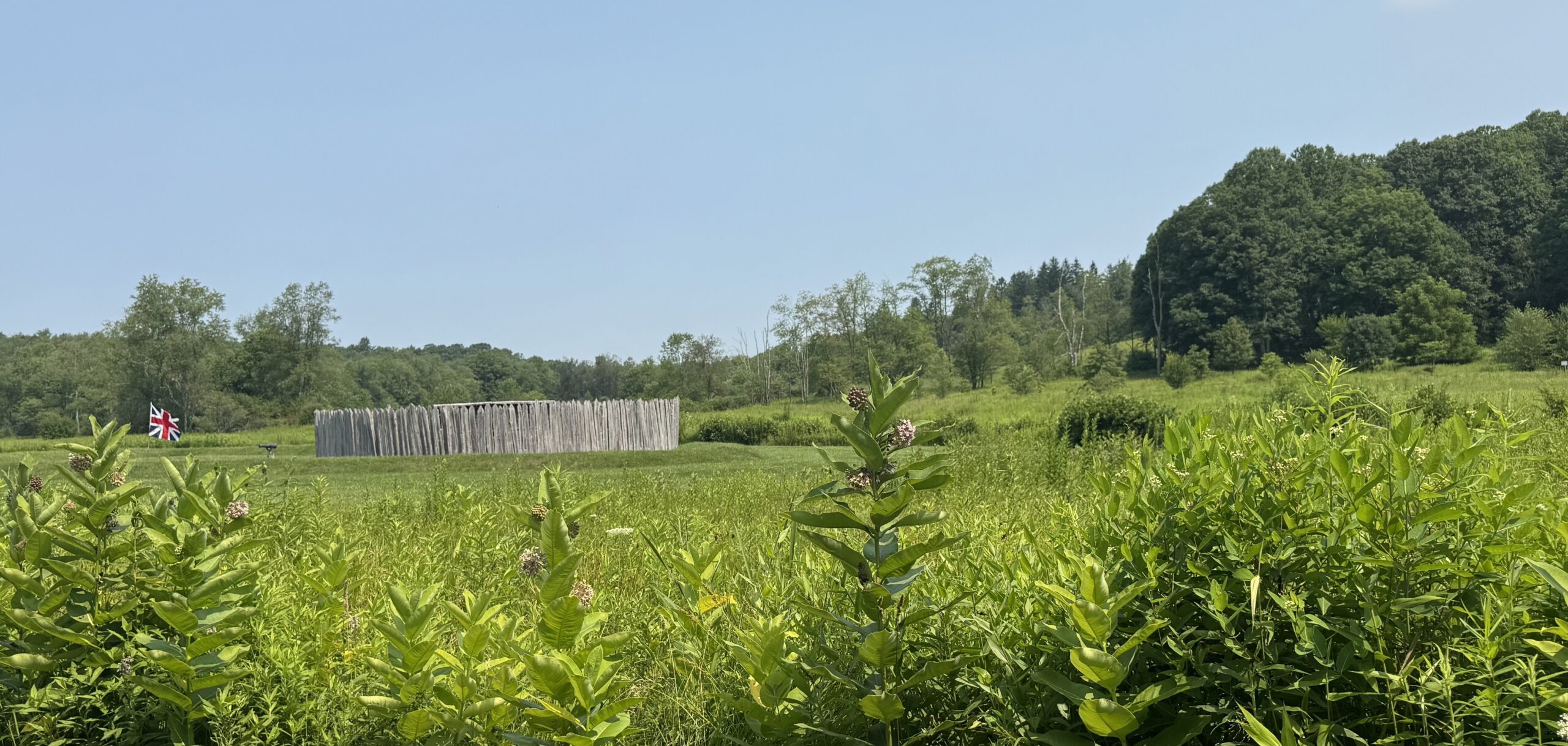
Fort Necessity National Battlefield
FAILURE
These days it’s hard to imagine Pittsburgh as an internationally strategic frontier outpost. But in 1754, during an expedition to claim it for the British, an inexperienced commander sustained defeat and surrender in the wilderness, his expedition igniting what we Americans call the French and Indian War.
After years of a cold war between the European powerhouses, tensions rose over both sides’ claims to the Ohio River valley. Controlling the confluence of the Alleghany and Monongahela rivers, where their waters mingle to become the Ohio, would secure dominance over the Ohio River valley and the lower Mississippi basin. That summer, British General Edward Braddock directed a military force to protect a construction crew at the confluence. A 23-year-old volunteer named George Washington, who previously had ventured into the area, was put in command. An expedition of 400 Virginia militiamen and British troops from South Carolina set out for the confluence, more than two hundred miles into the wilderness and beyond the Blue Ridge mountains hemming in colonial expansion.
This was, of course, long before the Interstate Highway System. Washington’s brigade literally cut a road into the hardwood forest, a tedious, exhausting task, one that wore down the soldiers even before the inevitable combat. On May 28, the British and about a dozen Mingo warriors ambushed a French force led by Joseph Coulon de Jumonville, capturing or killing the entire squadron. It would be a pyrrhic victory; Washington knew more French soldiers would quickly seek revenge.
Washington withdrew south and hastily constructed a fortification which he named Fort Necessity. A central storehouse was surrounded by a circular palisade about 50 feet across. A low line of berms encircling the fort provided a protective barrier. It wasn’t much, but Washington hoped it would hold out against an attack. With a quarter of his 400 men too ill to fight, Washington prepared for battle.
But Washington made a strategic blunder: Fort Necessity was constructed too close to the tree line, putting it well within range of French firearms. On a rainy July 3, 700 French troops and indigenous warriors opened fire Fort Necessity. Morale inside Fort Necessity was low, and soldiers expecting to die before sunrise drained the rum supply. But after eight hours of one-sided battle, the French inquired if Washington would surrender. Having lost 30 men and sustained another 70 injuries, Washington had little chance of winning and agreed to capitulate. The terms were gracious: The British could leave in the morning with honors. In turn, French prisoners would be returned, and Washington could not return to the area for a year. Two British officers would stay behind to guarantee Washington kept his word. The fort was quickly burned.
By any definition, Washington failed. What did the young officer feel as he retreated—Humiliated? Defiant? Humbled? Was his military career over before it ever started? What would Braddock say? Would he ever lead men again? What would happen to his reputation?
We know, of course, Washington redeemed himself, and it seems Braddock showed the young colonel mercy. A year later, Braddock led an army into the Ohio country, Washington at his side. Mortally wounded in battle, Braddock asked that Washington oversee his burial. Full-blown war was underway, lasting until 1763. Parliament passed the costs of war on to colonists in a series of taxes, eventually igniting the Revolutionary War.
Almost 30 years later, victorious and idolized, Washington returned to Fort Necessity. “I did not let the anniversary of the Fort Necessity battle pass without a grateful remembrance of our escape,” he said. “The same Providence that protected us…will, I hope, continue his mercies and make us happy instruments in restoring peace and liberty.”
Returning now to a reconstructed Fort Necessity, tucked in a peaceful glade of southwestern Pennsylvania 60 miles south of Pittsburgh, is an opportunity to imagine the United States in its earliest condition. The visitor center also has exhibits on the National Road, a road Washington helped clear. Stretching from Cumberland, Maryland, to Vandalia, Illinois, the National Road was a priority of the fledgling federal government, connecting a country that easily could have fragmented.
Washington’s first military leadership experience was an unequivocal disaster. But he overcame that failure, becoming an American hero and the first president. He refused to let failure define him.
What have you learned from one of your past failures? Has that changed how you view your mistakes now? How do you help others learn from their mistakes?